
Belly Fat Loss Program: The Most Effective Way Against Visceral Fat
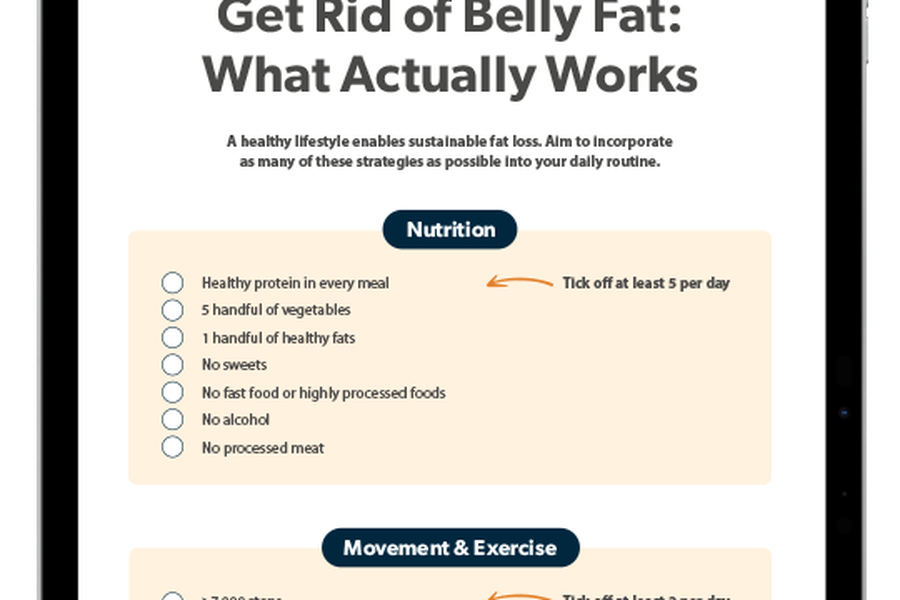
Lose belly fat specifically – without deprivation and complicated methods. Our everyday formula against belly fat helps you implement the most effective strategies directly into your daily life – for more health, energy, and a better metabolism.
)
Table of contents
For our ancestors, fat reserves around the midsection were crucial for survival. For us today, it represents one of our greatest health risks—even for people of normal weight. This is because not all belly fat is visible: a large portion is deep within the abdomen, directly attached to the organs and can strain the metabolism and cardiovascular system.
But how can you identify deep-seated belly fat, what risk factors contribute to it, and how can you get rid of it most effectively?
Why does the body store fat in the belly?
The human body does not store fat out of malice, but as a precaution. Fat is an energy reservoir—and the belly is a particularly popular storage location.
The abdominal cavity contains vital organs such as the liver, intestines, and pancreas. From an evolutionary biological perspective, it made sense to "cushion" these organs with energy reserves. Especially in times of stress or food scarcity, the body responds by storing more fat in the abdominal area. Hormones like insulin and cortisol play a crucial role in determining whether fat is stored in the abdomen or elsewhere.
Where does belly fat accumulate particularly?
Belly fat is not just belly fat. There are two fundamentally different storage locations:
Subcutaneous fat – the visible belly fat: This fat is located directly under the skin. You can grab it, pinch it, and see it. It primarily serves as an energy storage and heat insulation. While subcutaneous fat is visually bothersome, it is less dangerous from a health perspective.
Visceral fat – the invisible risk: Visceral fat lies deep in the abdominal cavity, between the organs. You don’t see it directly, but you feel its effect. This fat tissue is hormonally active and produces inflammation-promoting messengers. That is precisely why it is closely linked with:
Cardiovascular diseases
Diabetes Type 2
High blood pressure
Fatty liver
The "harder" and rounder the belly appears, the higher the proportion of visceral fat usually is.
Even slim people are affected
Who is slim is fit and healthy - that's what people think. But even thin people can suffer from too much body fat, hidden deep in the abdominal cavity. This phenomenon is called TOFI ("thin outside, fat inside"). The particularly insidious aspect is that while overweight people can see their extra pounds directly, TOFIs often remain unaware and live with a significant health risk without knowing it.
How do I find out if I have too much belly fat?
Too much belly fat—especially deep-seated, so-called visceral fat—cannot always be identified by body weight. Even slim people can be affected. An indicator is a protruding or harder midsection, even if arms and legs are slim.
The simplest and most meaningful test is measuring the waist circumference. Measure in the morning at the level of the belly button, standing and with normal exhalation. If the value is over 80 cm for women or over 94 cm for men, this indicates increased belly fat. From 88 cm (women) or 102 cm (men), the risk is considered significantly increased.
Waist circumference is more reliable than body weight or BMI, as it directly shows where fat accumulates in the body.
How do lifestyle and genetics influence the insidious belly fat?
1. Genetic predisposition
Genes influence where the body prefers to store fat. Some people gain weight first in the hips or legs, others almost exclusively in the stomach. This is not an excuse, but biologically measurable.
2. Age and hormonal changes
As we age, the metabolism slows down. At the same time, hormone levels change. In women, menopause plays a significant role, while in men, testosterone levels often decrease. Both promote the accumulation of visceral fat.
3. Chronic Stress
People with permanently high stress levels—either professionally or privately—often have elevated cortisol levels. The body is in "alarm mode" and tends to store fat primarily in the abdominal area.
4. Lack of sleep and shift work
Those who regularly sleep too little or live against the natural biorhythm significantly increase the risk of belly fat – even at a normal body weight.
Getting rid of belly fat? Please no strict diet
Many try to combat belly fat by counting calories or following radical diets. The problem: the body interprets this as renewed stress. The result is often muscle loss, while visceral fat remains stubborn or even increases.
Sustainable success is not achieved through renunciation, but through smart nutrition and the right exercise program.
The most effective measures against belly fat
1. The best belly fat-losing diet
With diet you can send important signals to your body. Particularly effective:
Daily two to a maximum of three healthy main meals, avoid snacks and maintain an overnight eating break of 12–16 hours.
Daily 1–1.4 grams of protein per kg body weight and ideally eat proteins in every meal, such as fish, eggs, legumes, yogurt.
Eat at least 30 grams of fiber daily, as they stabilize blood sugar and prevent excess energy from being stored as belly fat.
Avoid sugar and heavily processed products, instead opt for more slowly digested carbohydrates (vegetables, legumes, whole grains like buckwheat, quinoa, ...)
Fill plates according to the anti-inflammatory principle: 50 percent vegetables, 30 percent proteins, 20 percent whole carbohydrates. Plant foods provide antioxidants, which reduce cell stress and have anti-inflammatory effects, important because belly fat sends out particularly many pro-inflammatory messengers.
Daily healthy fats: nuts, avocado, olive oil satiate for a long time and support fat burning.
Daily 500 grams of vegetables and 200 grams of fruit.
2. Exercise – start small, big impact
You don’t have to be a marathon runner to see results. The most important thing is to make sport a routine. It is the regularity that makes the difference.
Strength and endurance training are essential for losing belly fat. Go to the gym 2–3 times a week.
Even more important: Be active in everyday life! Use stairs, take a daily walk or ride a bike more often.
3. Relieve stress – the underestimated factor
Stress is a real belly fat driver. If cortisol is chronically elevated, your body stores fat exactly where you don't want it. Small breaks, breathing exercises, meditation, or a walk in the fresh air often work wonders.
4. Sleep – the secret fat killer
Lack of sleep increases hunger hormones, shifts fat distribution, and practically guarantees cravings. 7–8 hours of well-planned sleep per night can do more than you think.
5. Consistency beats extremes
It's not about doing everything perfectly. Small, consistent steps get the body on a visceral fat reduction path. Day by day, week by week. Every step adds up – and your belly feels the difference.
Conclusion: Belly fat is not an unchangeable fate – everyone can get rid of it.
Belly fat does not disappear on its own, but every step you take today brings you closer to your goal. Eat consciously, move more, get enough sleep, and reduce stress – every change you start makes a difference. Start today with our Everyday formula against belly fat and thus promote your health step by step.
Everyday formula against belly fat
Download our belly fat reduction formula here.