

Vagus nerve: How to activate the nerve for health and serenity
Discover simple methods to stimulate the vagus nerve, reduce stress, and strengthen your physical and mental health.
)
Table of contents
Have you ever wondered how deep breathing, a conscious smile, or a short relaxation exercise can provide you with calm and clarity? Behind it is an inconspicuous but extremely effective nerve: the vagus nerve. It is our body's own rest and recovery button – unfortunately, we use its potential far too rarely in everyday life.
We show you what is behind this mysterious nerve, why it is considered a key to health today, and how you can simply activate it – for more inner peace, balance, and quality of life.
What is the vagus nerve?
The vagus nerve is the longest nerve in the human body. It begins in the brainstem and runs through the neck, chest, and abdomen. In doing so, it connects vital organs such as the heart, lungs, gastrointestinal tract, and the immune system. Its main function is to put the body in a state of rest and recovery. Among other things, it regulates heartbeat, breathing, and digestion. Unlike the sympathetic nervous system, which controls activation and stress reactions, the vagus nerve supports regeneration and inner stability. This gives it a crucial influence on our physical and mental health.
What functions does the vagus nerve have?
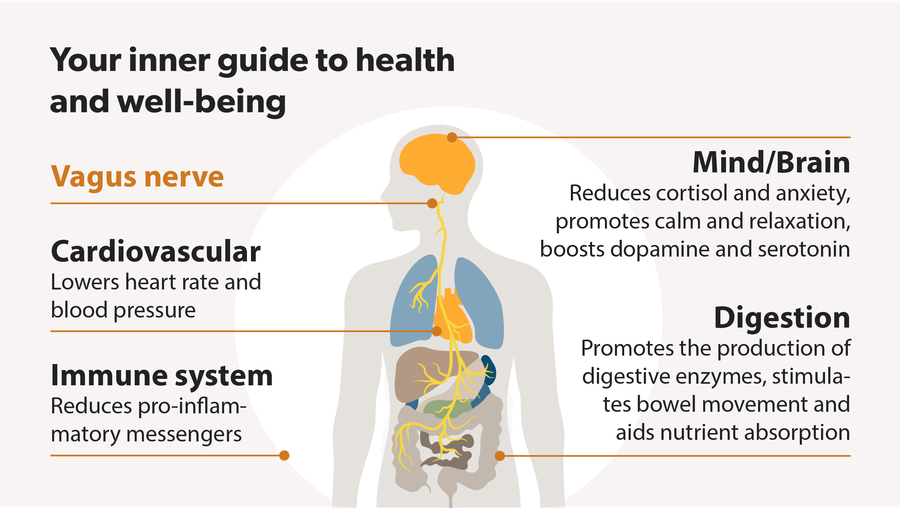
In short: The vagus nerve is a true quality of life booster. Anyone who strengthens it not only supports individual body functions but also the interaction of the entire organism.
In specialist circles, the vagus nerve is sometimes also referred to as "self-healing nerve" designated – not because it heals diseases, but because it promotes central processes that are crucial for regeneration and healing. Its importance is also evident in medicine: For certain diseases, the vagus nerve is now even permanently electrically stimulated to specifically utilize its regulating effect.
It is remarkable how strongly our well-being is influenced by a single, often inconspicuous nerve – and how rarely this knowledge has been consciously used so far.
Two-thirds of Germans feel stressed
Wars, work, appointments: More and more people feel constantly stressed and rarely come to rest. A representative survey by the Techniker Krankenkasse1 shows that about two-thirds of all adults in Germany report being frequently or at least sometimes stressed. The causes: too high demands on oneself (61 percent), school, studies or work (58 percent), political and social problems (53 percent) or too many appointments and obligations in leisure time (43 percent).
How to activate the vagus nerve?
It's really quite simple because the vagus nerve responds to straightforward, easily implementable stimuli:
Deep abdominal breathing – the easiest way to relax: Slow, conscious inhaling and exhaling has been proven to calm the heart and mind. Just a few minutes of deep abdominal breathing a day can noticeably create calmness and increase vagal activity.
Tip: Try box breathing or also 4 seconds inhaling, 6 seconds exhaling – this slight extension of exhaling enhances the effect.
Humming, singing, loud laughing: The vibrations in the throat stimulate the nerve and not only create good cheer but also relaxation. You now officially have permission to sing in the shower or hum your favorite song for 3–5 minutes.
Cold – the quick wake-up for the vagus nerve: Cold water on the face, on the forearms or short cold showers boost vagal activity.
Movement: The vagus nerve reacts positively to gentle movement. Yoga, stretching, Pilates, or moderate endurance training improve nerve activity, promote blood circulation, and help to reduce stress hormones. Particularly effective are exercises where the breath is consciously connected with movement, e. g. in yoga flow or slow stretching.
Tip: 15–20 minutes of gentle movement daily is enough to noticeably improve vagal function.ürbar zu verbessern.
Mindful eating: The vagus nerve is a central communication channel between the gut and the brain – often referred to as the “gut-brain axis”. A healthy gut supports this communication and can help to reduce stress and promote inner calm. You can specifically strengthen this connection: A fiber-rich, unprocessed diet and probiotic foods support the gut flora. Slow, conscious eating and thorough chewing activate digestion and signal to the body: Everything is okay, relaxation can commence. It's important to take time for eating and to chew thoroughly.
Your Vagus Nerve – the Key to More Quality of Life
When you start to consciously activate the vagus nerve, you will step by step feel how body and mind come to rest faster and, above all, together. The stress that often accompanies us even into the bedroom is reduced and we can enjoy our free hours more relaxed. The vagus nerve is your biological reset button – it's just a question of whether you use it consciously.